|
The
Blessed Virgin Mary is the mother of Jesus. Jesus is the Son of God, for this
simple reason, Mary is the mother of the Son of God.
Jesus
is not only the Son of God but is also God, if we contemplate the mystery of the
Holy Trinity, by which we say that God is three different persons but one true
God.
Jesus
is the Word of God incarnate, God Himself. He who said to the Apostle Philip, He
who sees me has seen my Father, because the Father and I
are One.
Gospel
of Saint John
14:8 Philip said to Jesus: Lord,
show us the Father, and it is enough for us.
9 Jesus said to him: I have been for such a long a time with you; and you have not known me? Philip, he that
sees me sees the Father also. How can you say, Show us the Father?
10 Do you not believe, that I am in the Father, and the Father in me? The words that I speak to you, I speak not of myself. But the Father who
abides in me, is the one who does the works.
John
10:30 I and the Father are one.
According to this affirmation, Jesus is claiming the divinity of the
Father and is calling himself equal to God. In other words, Jesus
is God.
Elizabeth
praised God and exalted Mary calling her Mother of her Lord, Mother
of God.
Luke
1:43 y 43 And why has this happened to me, that the Mother of my Lord should come to me?
Eliz
The
Apostol also called Him God: John 20:28 Thomas answered Him: My
Lord and my God.
The
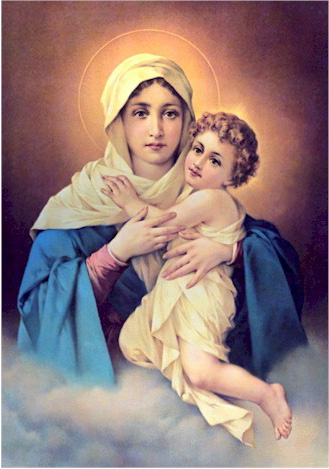
Blessed Virgin Mary is the Mother of Jesus, Jesus is God, the Virgin Mary is the
Mother of God.
January
1st is the first day of the year. The Holy Catholic Church has dedicated
this day as as " Solemnity of Mary, Mother of God " in honor of the
blessed maternity of Our Lady.
Mother of God
Apologetics
It is often the case that one would hear the title of "Mother of
God" as applied to the Blessed Virgin Mary disparaged as "Mariolatry" or
blasphemy. Such an attack is normally coupled with the opinion that Catholics give too
much honour to the Virgin Mary, and that She is not so important because little is said of
Her in Sacred Scripture. What justification, therefore, can there be for such a title?
In the first book of the Old Testament we read the following: "I
will put enmity between you and the woman, and between your offspring and hers; he
shall bruise your head, and you shall bruise his heel" (Gen. 3, 15). This
verse, called the "protoevangelion," is the first promise of the
redeeming Messiah. The woman in this verse is the Virgin Mary, Her offspring is, of
course, Our Lord Jesus Christ. Despite the fact that there is distinct controversy among
Biblical scholars as to whether the text should read "she", "he" or
"it shall bruise"(or crush), the meaning is the same, as it is through
Her Son, Our Lord Jesus Christ, that the Virgin Mary crushes Satan.1
Genesis 3, 15, together with the following passages, form the basis for
venerating the Virgin Mary as Mother of God:
"Behold, a virgin shall conceive and bear a son, His name
shall be called Emmanuel (i.e., God with us)" (Is. 7, 14
[Douai]);
"For a child has been born for us, a son given to us; authority
rests upon his shoulders; and he is named Wonderful Counselor, Mighty God,
Everlasting Father, Prince of Peace" (Is. 9, 6);
"And the angel being come in, said unto her: Hail, full of
grace, the Lord is with thee: blessed art thou among women" (St. Luke
1, 28 [Douai]);
"(St. Elizabeth to Our Lady) And why has this happened to
me, that the mother of my Lord comes to me?" (St. Luke 1, 43);
"...for he has regarded the low estate of his handmaiden.
For behold, henceforth all generations will call me blessed" (St. Luke
1, 48);
"...Woman, behold your son...(Son) behold your mother"
(St. John 19, 26-27);
"Then God's temple in heaven was opened, and the ark of his
covenant was seen within his temple; and there were flashes of lightning, rumblings,
peals of thunder, an earthquake, and heavy hail" (Rev. 11, 19). The Ark of
the Covenant was a symbolic type of the Virgin Mary. The original Ark was overladen with
gold and contained within itself a pot of manna, Aaron's priestly rod, and the two tables
of the Ten Commandments (Heb. 9, 4). It was overshadowed by a propitiatory, or
mercy seat, upon which God Himself dwelt (the Shekinah) between two statues of
Cherubim (Exod. 25). It was forbidden for anyone to touch the Ark on pain of death.
The Virgin Mary, in comparison, was a greater Ark, being a human creature immaculately
conceived who carried within Her womb not simply the symbols of Christ, but Christ
Himself. God, likewise, overshadowed Her, when the Holy Spirit conceived Christ within
Her. Being a perpetual virgin, no one could, or did, "touch" Her. Joshua
prostrated himself and venerated the Ark for hours (Josh. 7, 6). As
"Joshua" means "Jesus" we have a type of Jesus venerating a type of
Mary. Applying this to the New Testament figures themselves, it symbolically represents
Jesus Christ paying veneration to His Mother.2
"A great portent appeared in heaven: a woman clothed with the
sun, with the moon under her feet, and on her head a crown of twelve stars" (Rev.
12, 1);
"And she gave birth to a son, a male child, who is to rule
all the nations with a rod of iron. But her child was snatched away and taken to God and
to his throne" (Rev. 12, 5);
"Then the dragon was angry with the woman, and went off to
make war on the rest of her children, those who keep the commandments of God and hold the
testimony of Jesus" (Rev. 12, 17).
The Church distinguishes clearly between dulia, or
"the homage of veneration," and latria, which signifies "the
worship of adoration." Veneration is paid to the Saints; a higher form of it, called hyperdulia,
is given to the Virgin Mary; but adoration is given only to God. Any attempt to give
adoration to a creature would certainly be idolatrous - but the Catholic Church has never
given it. She adores God and God alone.
Most Protestants abhor the title of "Mother of God" because
to them it insinuates that Catholics believe that the Virgin Mary existed before God, and
that God only came into existence after being born from Her. Such, of course, is an
absurdity. In fact, the term "Mother of God" was defined by the Council of
Ephesus (431 AD) in response to the Christological controversy ignited by
Nestorius, then
Patriarch of Constantinople. Nestorius asserted that in Christ there existed not one
divine Person with two natures, human and divine, but two Persons, one human and
one divine, with two natures, human and divine. Further, these two persons were not
hypostatically united, but separate, the human being insignificant compared to the divine.
Consequently, the Virgin Mary, as She supplied only Christs human flesh and not His
divinity, was only mother of Christs humanity and therefore in no sense could be
called Mother of God. The Church, upholding that Christ was one divine Person only, and
noting that Mary was the mother of this divine Person (St. John 19, 25), defined
dogmatically that She could properly be called "Mother of God":
"If anyone does not confess that the Emmanuel is in truth God, and
that the Holy Virgin is Mother of God, because she bore according to the flesh of the Word
of God when He became flesh: let him be anathema."3
St. Cyril of Alexandria would continue defending of the title
"Mother of God" in the years after Ephesus:
"The Word, then, was God, and He became also Man; and since He was
born according to the flesh for the sake of mankind, it is necessary that she who bore Him
is the Mother of God. For if she did not bear God, neither is He that was born of her to
be called God. If the divinely inspired Scriptures name Him God, as God having been made
man and incarnate, He could not become Man in any other way than through birth from a
woman: how then should she who bore Him not be the Mother of God?"4
For the past fifteen centuries the Church has steadfastly continued to
bestow the title "Mother of God" upon the Virgin Mary:
"Glory to God in the highest; and on earth peace to men of good
will. Then began the fulfillment of the splendid promise made by God to Abraham, that in
his seed all the nations of the earth should one day be blessed; for Mary, whom we truly
proclaim and venerate as Mother of God, because she brought forth Him who is at once God
and man, was descended from King David."5
"The Virgin Mary
is acknowledged and honoured as being
truly the Mother of God and Mother of the Redeemer."6
"Glorious Theotokos
"7
"Called in the the mother of Jesus, Mary is
acclaimed by Elizabeth, at the prompting of the Spirit and even before the birth of her
Son, as the mother of my Lord. In fact, the One whom she conceived as man by
the Holy Spirit, who truly became her Son according to the flesh, was none other than the
Fathers eternal Son, the Second Person of the Holy Trinity. Hence the Church
confesses that Mary is truly Mother of God (Theotokos)."8

|