|
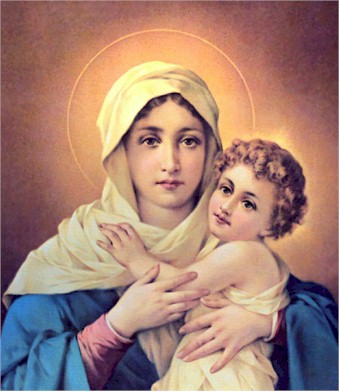
Immaculate
Conception is the title by which we recognize that the Blessed Virgin Mary by a
special grace of God was exempt of original sin. She announced herself with this
title to Bernadette Soubiruous in the Apparitions of Lourdes in 1858.
The authenticity of
these apparitions has been verified by the authority of the Church in view of
the great number of miracles that have taken place in the Sanctuary of
Lourdes.
The
Immaculate Conception was solemnly defined and proclaimed by Pope Pius IX on
the 8th of December 1854/
It is very dignifying
for Mary to be the Mother of Jesus, the Son of God. She is the new Eve, created
without a stain of sin to be the Mother of Jesus and of all the children of God.
We
all have inherited the original sin from Eve, the mother of all the children of
Adam. Since Jesus is the new Adam, her mother was created with this unique
privilege of being free from original sin.
Our
Lord Jesus Christ consecrated us as children of Mary in the person of John the
beloved apostle when he was in agony on the cross. To
John He said, there is your mother, to Mary He said as He gave her all the
children of God: here is your son.
The children of Mary
are the children of God in His Divine Grace, all saved by Jesus, who accept Mary
as their mother.
Immaculate Conception
Apologetics
The Immaculate Conception is the Virgin Marys glorious privilege
of being preserved by a special grace of God from Original Sin through the future merits
of Jesus Christ.
Protestants assert that the Virgin Mary could not have been
immaculately conceived for then She would not have needed redemption. This is evidenced by
Her own words in the Magnificat: "my spirit rejoices in God my Saviour" (St.
Luke 1, 47). Further, St. John clearly states that "If we say that we have no sin
we deceive ourselves and the truth is not in us?" (1 St. John 1, 8). How can
Catholics therefore claim that the Virgin Mary was sinless?"
The Catholic Church does not deny that the Virgin Mary needed
redemption, for She was a child of Adam together with the rest of humanity. Yet, Her
redemption was effected in another, "more sublime manner", namely, "redemption
by pre-emption." One can be cured of a disease after having contracted it, or one
can be spared of that same disease by being inoculated against it in advance. The Virgin
Marys redemption was effected in this latter manner, thus sparing Her from ever
being under Satan's domination.
The Immaculate Conception of the Virgin Mary was solemnly defined and
proclaimed by Pope Pius IX on the 8th December, 1854:
"The most Blessed Virgin Mary was, from the first moment of her
conception, by a singular grace and privilege of almighty God and by virtue of the merits
of Jesus Christ, Saviour of the human race, preserved immune from all stain of original
sin."17
The Immaculate Conception has always been the belief of the Church,
being implicitly contained in the Churchs teaching of the Virgin Marys
absolute purity and sinlessness. Just as Our Lord "grew in grace and wisdom,"
that is, manifested increasing signs of wisdom as He increased in age, so the Church,
which possesses the wisdom of God from Her origin, manifests it only according to the
order of Providence and Her childrens needs. In the centuries before 1854, the Popes
and Councils made continuous and explicit references to the Immaculate Conception in their
pronouncements:
(i) Pope St. Martin I, Lateran Council (649), Canon 3 on the Trinity;
(ii) Pope Sixtus IV, Constitutions Cum Praeexcelsa (1476); Grave
Nimis (1483);
(iii) Pope Paul III, Council of Trent (1546), Decree on Original Sin;
(iv) Pope St. Pius V, Bull Ex Omnibus Afflictionibus, (1567);
(v) Pope Alexander VII, Bull Sollicitudo Omnium Eccl. (1661).18
The Church finds support for the doctrine of the Immaculate Conception
in the words of the Angel Gabriel to the Virgin Mary: "Hail, full of grace,
the Lord is with thee; blessed art thou amongst women" (St. Luke 1, 28
[Douai]). She, who was to conceive the Son of God, the Holy of holies, must
Herself be supremely holy, and therefore be preserved, not only from actual sin, but also
from all stain of Original Sin. The Angels words would not have been entirely
truthful had the Virgin Mary, for even one instant, been deprived of grace.
St. Luke 1, 28 continues to be a source of much controversy. Most
Protestants would prefer to render the original Greek kecharitomene as "highly
favoured" rather than "full of grace." In fact, a strict translation of kecharitomene
is "thou who hast been graced." Of the two options, "full of
grace" is a more clear and definite rendering of the angels words than
"favour." For this conclusion there exists the authority of the Latin Fathers;
the Codices of Alexandrinus and Ephrem; the Syriac and Arabic versions of the Bible; and
even the writings of Protestants such as Wycliffe, Tyndale, and Beza.19
The Church, furthermore, asserts that God, immediately after
Adams fall, cursed Satan and said, "I will put enmity between you and the
woman, and between your seed and her seed; he shall bruise your head" (Gen.
3, 15). It was by the Virgin Mary's seed, that is, Jesus Christ, that the kingdom of Satan
was demolished. It was not fitting that She, who was to co-operate in the defeat of Satan,
should ever be infected by his breath or a slave to his kingdom of sin. The enmity
between the Virgin Mary and the serpent placed by God was Her triumph over sin, Her
Immaculate Conception.
To the contrary, however, it is asserted that the Virgin Mary again
admitted that She was a sinner when She presented herself in the Temple for purification
in accordance with the Law of Moses: "she shall take two turtledoves or two pigeons,
one for a burnt offering and the other for a sin offering; and the priest shall make
atonement on her behalf, and she shall be clean'" (Lev. 12, 8). The Virgin
Mary observed this Law not because She believed Herself to be defiled by giving birth to
Christ, but to give an example of humility and obedience by fulfilling all outward
observances. For the Virgin Mary was not subject to this particular law by virtue of what
God Himself had laid down in prefacing it: "If a woman having received seed shall
bear a man child, she shall be unclean seven days..." (v. 2 [Douai]). The conception
and birth of Christ was not due to the reception of male seed but rather to the power of
the Holy Spirit. In no way can it be claimed that in conceiving, bearing and delivering
Christ the Virgin Mary was made "unclean." In fact, the opposite would have
occurred, that is, She would have received an augmentation of grace.20
That God should have created the Virgin Mary in a state of holiness as
He had formed Eve and the angels is also befitting the honour of God: of the Father, whose
daughter She is; of the Son, whose mother She is; and of the Holy Spirit, who, in the
incarnation, took the Virgin Mary to be His spouse. Further, as the "new Eve"
and mother of the new Adam, the Virgin Mary cannot appropriately be anything less than the
original Eve; on the contrary, as Christ excelled Adam, so the Virgin Mary (though to a
lesser degree) should excel Eve. Tradition and the Magisterium of the Church has
consistently and universally proclaimed the sinlessness of the Virgin Mary:
"Our most holy, immaculate, and most glorious Lady, Mother of God
and ever Virgin Mary."21
"It was meet that the God of all purity should spring from the
greatest purity, from the most pure bosom."22
"Most holy Lady, Mother of God, alone most pure in soul and body,
alone exceeding all perfection of purity...my Lady most holy, all-pure, all-immaculate,
all-stainless, all-undefiled, all-incorrupt, all-inviolate."23
"With the exception therefore of the Holy Virgin Mary, with
regard to whom, when sin is in question, I cannot, out of respect of Our Lord, permit of
any discussion."24
"By virtue of the richness of the grace of the beloved Son, by
reason of the redemptive merits of him who willed to become her Son, Mary was preserved
from the inheritance of original sin. In this way, from the first moment of her conception
- which is to say of her existence - she belonged to Christ, sharing in salvific and
sanctifying grace and in the love which has its beginning in the 'Beloved', the Son of the
Eternal Father
"25
"The 'splendor of an entirely unique holiness' by which Mary is
'enriched from the first instant of her conception' comes wholly from Christ: she is
'redeemed, in a more exalted fashion, by reason of the merits of her Son.' The Father
blessed Mary more than any other created person 'in Christ with every spiritual blessing
in the heavenly places' and chose her 'in Christ before the foundation of the world, to be
holy and blameless before him in love."26
Finally, for Catholics, the infallible pronouncement of Pius IX was
given heavenly ratification by the Virgin Mary Herself when She appeared at Lourdes in
southern France in 1858 and announced to St. Bernadette Soubirous that She was "the
Immaculate Conception." The subsequent flow of thousands of miracles stemming
from the waters of the Lourdes grotto attest to the authenticity of the Virgin Marys
apparitions and are a matter of public record for all to examine.

|